Journal
The quiet season, mid-April in Schnann
7 min read · June 2026
By mid-April, the valley floor at Schnann has turned green. Not the pale, tentative green of very early spring, but something fuller and more settled — the fields between the road and the treeline have taken on colour while the peaks above them are still white. The contrast is not picturesque in a designed way; it is simply what happens here in April, and it looks exactly like what it is: a mountain landscape in the act of changing.
The days are long. Sunrise is before six-thirty; the light stays until past eight in the evening. If the sky is clear, those fourteen hours are good hours — the kind of April light that is brighter and more even than anything winter produces, without yet having the heat of full summer. The temperature in the valley sits somewhere between six and twelve degrees on most afternoons. At altitude it is cooler, and above 2,000 metres the snow is still firm.
Most people are not here.
That last fact is worth sitting with for a moment. The Arlberg in February is one of the busiest ski destinations in the Alps — lift queues at peak school holiday times, restaurants full by noon, the Nassereinbahn in St. Anton moving continuous lines of people upward through the morning. By mid-April, none of this is true. The buses still run. The valley still functions. But the feeling of the place has completely changed.
Schnann in April is, in some ways, more itself than it is in February. The village is not designed for tourism; it simply exists, and in winter it hosts a great many visitors while remaining essentially itself. In April, the visitors are fewer, and what remains is the village — the single road, the old church, the sound of the Rosanna running fast with snowmelt, the occasional tractor moving between fields.
This is not a consolation prize. It is a different thing entirely.
What is still possible
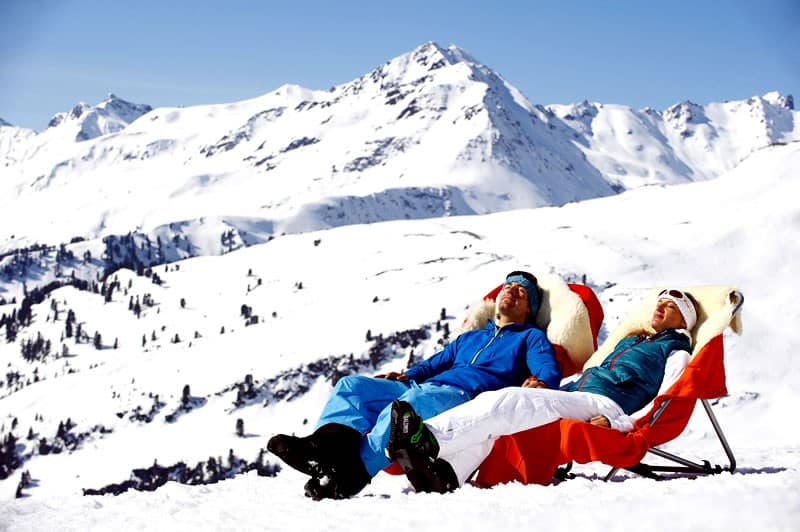
Skiing, depending on the year. The St. Anton ski area typically operates deep into April, and in years with a good snowpack — which is to say, most years at the Arlberg — there are still extended days of skiing available in the second and third weeks of the month. The upper lifts are the last to close, and the snow at altitude can be excellent at this time of year: firmer in the morning, softening by midday to something reminiscent of spring conditions. The crowds are gone. The queues are short or absent. A day on the mountain in mid-April can be among the best of a season, if you are willing to check the dates and take the chance.
It is worth being direct about the variability here. Lift operating dates at the Arlberg depend on snowpack, weather, and commercial decisions that differ year to year. Before planning an April trip around skiing, check the official Ski Arlberg website for the current season's closing dates. What can be said with confidence is that the area closes later than most people expect.
Hiking is the other dimension of April that surprises visitors. The trails at lower elevations — the valley paths along the Rosanna, the lower sections of the routes that lead up toward the Verwallgruppe to the south of the valley — become accessible before the high mountain paths clear. In April, the snowline is at roughly 1,500–1,800 metres depending on aspect and the year's conditions, which means a reasonable amount of low and mid-elevation walking is possible on dry, good-weather days. The Schnanner Klamm, the gorge carved by the river through the limestone above the village, typically opens for the season in spring and is worth the walk.
The pace of the village
In winter, the village is a corridor. People pass through on the way to the ski bus and back. There is little reason to linger on the street.
In April, the pace is different. There is no reason to move quickly, and so people — the people who are here — tend not to. A walk to St. Roch's Church at the edge of the village, built in 1633, and further up toward the treeline if the afternoon allows. A longer coffee than usual. The bus to St. Anton for a meal or an errand, without any urgency about the return time. These are small things, but they compose a kind of holiday that is different in character from a ski week at peak season.
The apartment itself feels different too. In February, the house is used the way a ski apartment is used: gear by the door, meals fitted around the mountain, evenings truncated by tiredness. In April, there is more time to be in it. The long wooden table in the Hoher Riffler becomes a place for a morning of reading as well as a meal. The balcony at the Eisenspitze, facing south, gets real afternoon sun by mid-April — warm enough to sit out in with a coat, occasionally without one. These are not dramatic experiences. They are the ordinary pleasures of being in a good place with time to use it.
Practical notes for April
Some things will be closed. A number of restaurants and businesses in the valley follow the ski season — they close in late March or early April and do not reopen until the summer season begins, which is typically in June. This is not a problem if you are planning to cook in the apartment (which is set up for exactly that), and St. Anton itself has year-round establishments, but it is worth knowing before you arrive.
The weather in April is variable. Spring weather in the Alps is not yet stable: warm, clear days alternate with overcast periods, and occasional late-season snowfall in the valley is not unusual. Pack for both possibilities — the same warm base layers you would bring for skiing still apply; a waterproof layer; and something light for the warm afternoons. The swing from morning cold to afternoon warmth can be fifteen degrees within a single day.
The roads are clear and conditions are easier than at any point during winter. The stress of a February drive — tyre chains, heavy snowfall, difficult passes — is largely gone by April. Arriving by train and using the bus in the valley is also straightforward at this time of year.
People who return to Schnann in April sometimes struggle to explain exactly why. The skiing, if there is skiing, is good. The walking is pleasant. But those are not the whole of it.
There is something particular about a place that has just had its busiest season and is now breathing again. The valley in April has a quality of settling — the mountains unchanged, the fields returning, the river loud with the snowmelt coming off the high slopes. The light holds until evening. There is no queue for anything. Barbara and Evert are less stretched, and the hospitality has a different quality: not less attentive than in February, but less pressured, more like the way you might have a friend stay than the way you run a busy season.
Some guests come in February and come back in April to see what the other version looks like. Most of them come back again.