Journal
A week in the Stanzertal
8 min read · June 2026
The drive from Innsbruck takes about an hour. You leave the motorway at Landeck-West, and almost immediately the landscape changes register. The Inn valley is broad and institutional — a main road, a railway line, the infrastructure of a valley that connects things. But at Landeck you turn west, and the road narrows and the valley closes in around you, and within a few minutes you are following the Rosanna river through country that is not trying to be anything other than what it is.
The villages come and go. Strengen. Flirsch. Pians. Single streets with farmhouses and churches and woodpiles stacked against the coming winter. By the time the sign for Schnann appears, you are already inside the valley's logic — smaller, quieter, more particular. You turn off the main road, drive fifty metres, and stop.
That is the arrival.
Schnann is a single-street village in the municipality of Pettneu am Arlberg, postal code 6574. These facts are not especially evocative, but they are useful: they tell you something about the scale of the place before you see it. There are a few hundred residents. There is a church — St. Roch's, built in 1633, at the edge of the village — and a bus stop a minute's walk from the house. There is no resort centre. No high street. No après-ski bar.
What there is: the mountains, and the valley, and the particular quality of stillness that comes from being surrounded by both.
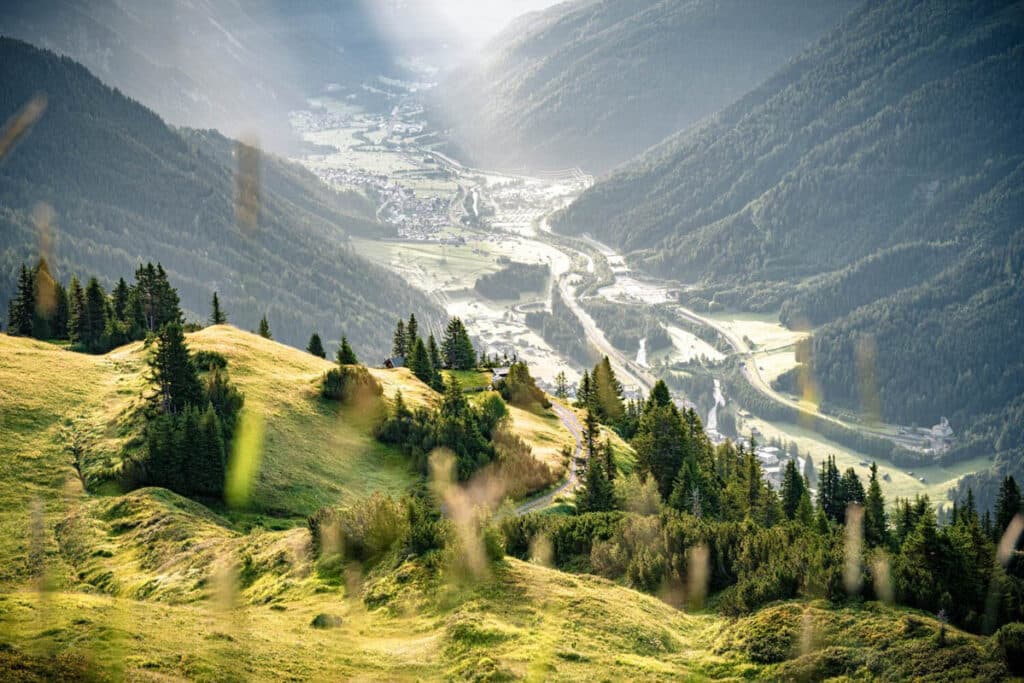
The Stanzertal runs east-west here, connecting the Arlberg pass in the west — where the road crests into Vorarlberg — to the Inn valley near Landeck in the east. It is a working valley as well as a scenic one: the main road, the railway line, and the river share the valley floor, and the villages are arranged along the road at intervals that feel like a different era's logic rather than a planner's. From the south-facing windows of the apartments, you can watch the light move across the slopes on the far side of the valley through most of the day. In the morning, the high peaks catch it first — pale and angled. By midday, the whole visible face of the mountain is in sun. By four in the afternoon, the valley floor is already in shadow and the light retreats up the slopes until only the ridgeline is still bright. This happens every clear day, in a slightly different way each time.
On the first morning, the cold is an event in itself. Not the damp, grey cold of the lowlands, but something drier and more direct — the kind that arrives with the first breath outside the door and settles immediately into the back of the nose. If it snowed overnight (and the Arlberg averages over 200 snow days a year, so the chances are reasonable), the road will be quiet and the air will carry the specific smell of fresh snow and woodsmoke that is almost impossibly associated with this kind of morning.
Breakfast at the long wooden table in the kitchen. Coffee. The mountains through the windows. No particular rush — the ski bus comes every thirty minutes, and the first decent light doesn't reach the upper pistes until eight-thirty or nine.
Bus line 4242 stops in the village and takes you into St. Anton in ten minutes. From there, the Nassereinbahn — the main cable car on the eastern side of the ski area — carries you up into the Arlberg. The ski area is large in the way that is difficult to fully grasp until you are inside it: 305 kilometres of marked pistes, 88 lifts, connections westward through St. Christoph and Stuben to Lech, Zürs, and eventually Warth-Schröcken. On a clear day with good snow, a long-legged skier can cover an implausible amount of ground.
Most people don't try. Most people find their runs and repeat them, learning the mountain in layers over several days. This is not a failure of ambition. It is what a week of skiing actually feels like when you are doing it right.
Coming back from the mountain in the late afternoon is a different experience than if you were staying in St. Anton itself. The bus brings you out of the crowd and deposits you in the village, and the transition is immediate. Ahead is the apartment, warm underfloor heating if the evening is cold enough, and a few hours with no programme.
This is the thing that is hardest to describe to someone who has not done it. The ski area is shared — it belongs to everyone who buys a lift pass. The evening is not. A hotel in St. Anton at this time of year is rarely quiet. The apartment in Schnann is, almost by definition, exactly as quiet as you want it to be.
The Stanzertal after dark is a different valley from the one you saw on the way in. The mountains disappear; what remains are the lights of the villages strung along the valley floor — Pettneu on the other side, Flirsch further east — and the sound of the Rosanna, somewhere below the road, still moving fast despite the cold.
Some afternoons there is time for a walk. Not the Schnanner Klamm in deep winter — the gorge cut by the river through the limestone above the village is only fully accessible from spring onward — but along the valley road toward Pettneu, or up through the fields behind the houses to where the treeline begins and the slope changes angle and you can see, for the first time, how the valley sits in relation to the mountains above it. In deep winter, you go where the packed snow allows. In the shoulder seasons you go further, and the Klamm itself is worth the walk: a narrow limestone gorge, the river loud and fast below, the walls close enough to touch on both sides. It is one of those places that exists in complete indifference to whether anyone comes to see it.
The village itself rewards slow attention. St. Roch's Church, dating from 1633, is small and serious in the way that mountain churches tend to be — built for people who lived year-round in difficult country, not for visitors. The building has been modified over the centuries but the core of it is very old, and standing in front of it on a morning when the air is clear and the mountains are fully visible behind it, it is easy to understand why someone built it exactly here.
By the middle of the week, the shape of the days is established. The bus in the morning. The mountain. Lunch somewhere on the piste, or brought from the apartment. The bus back. An evening that could be anything — dinner in the apartment, a short drive into St. Anton for a meal, a quiet hour on the balcony with the valley below. The rhythm is not monotonous; it is, in the literal sense, composed.
If you take the bus into St. Anton one evening — and it is worth doing at least once — the contrast is vivid. The town has a genuine centre: a pedestrian street, restaurants and bars, the compressed energy of a ski resort at full volume. The history is real too: St. Anton's claim to be the birthplace of Alpine skiing is not entirely marketing, and the skiing museum there is worth an unhurried hour. None of this is objectionable. But by nine o'clock, most visitors are glad to take the bus back west through the valley, past the darkened fields, to the apartment and the kind of quiet you do not get in a resort.
The Stanzertal is not a landscape that announces itself. It is not the dramatic verticals of the Lech valley to the west, nor the wide open floor of the Inn valley to the east. It is contained — two ridgelines, a road, a river, a scatter of villages — and it asks a certain patience from the people who come to it. Those who give it that patience tend to come back.
The reasons, when people articulate them, are often similar. Not the skiing, though the skiing is excellent. Not the apartment, though the apartment is comfortable and genuinely well considered. Something about the scale of it: a week in a house rather than a hotel, in a village rather than a resort. The mountains are the same mountains. The pistes are the same pistes. But the morning is slower, and the evening is quieter, and the week ends feeling more like a rest than a recovery.
Schnann. Easy to reach. Hard to leave.